
Origins: Sin, Sickness & Corn Flakes
May is International Masturbation Month. A time of self-ere – self-reflection…self-appreciation. We are going to rub this one out in two sections. So keep your eyes on the screen, and hands where I can’t see them. Unsurprisingly, self-pleasure can be a big topic of shame, but like most qualms related to sexuality, that was not always the case. Ancient civilizations like Egyptians and Greeks viewed and treated masturbation as unremarkable and sometimes sacred – a spiritual experience. In the modern world, information contradicts itself depending on who is talking about it. Some still speak with a tone of guilt and shame about it, others choose to walk like an Egyptian. That confusion, or divide, or grey area, comes from somewhere. Shame has an origin point. For this first blog, we will be diving into the historical conversation, and finding where that point is. Spectating where in history individuals got to decide how to define what normal was, and how others were treated when they didn’t comply.
The first place my mind went, likely yours too, is religious bodies’ condemnation of self-pleasure. Doctrine doesn’t always equate to behavior though, and everything is up to interpretation. Take the core three Abrahamic traditions, Christianity, Islam and Judaism. All three relate back to The Story of Onan in Genesis. The story has served as an after-school special in sermons as the main tool for claiming masturbation was sinful, a waste of “spilled seed”. Those who have studied the religious text have concluded that the act described in this story was actually about coitus interruptus. Now let’s break it down for a motherfucker. Coitus meaning sexual intercourse; Interruptus meaning interrupted or retreated. In today’s terminology, we would call this “The pull-out” method. The Talmud describes it as an act equal to murder. Over time, Reform Judaism has gone soft on that notion. Christianity condemned it as the secret sin, the Catholic Church called it a gravely disordered action, Jehovah’s Witnesses called it unclean. Islamic views offer a substitution for the deed: marriage. Yet, masturbation is still practiced by believers, whether they admit it or not.
A note from the writer:
During my research for this section, I sifted through academic journals. One of the most fascinating things I found was not in any of the research, but in the predictive search bar results showing me what others were searching for. The third suggestion was “How to release sperm as a Christian?”
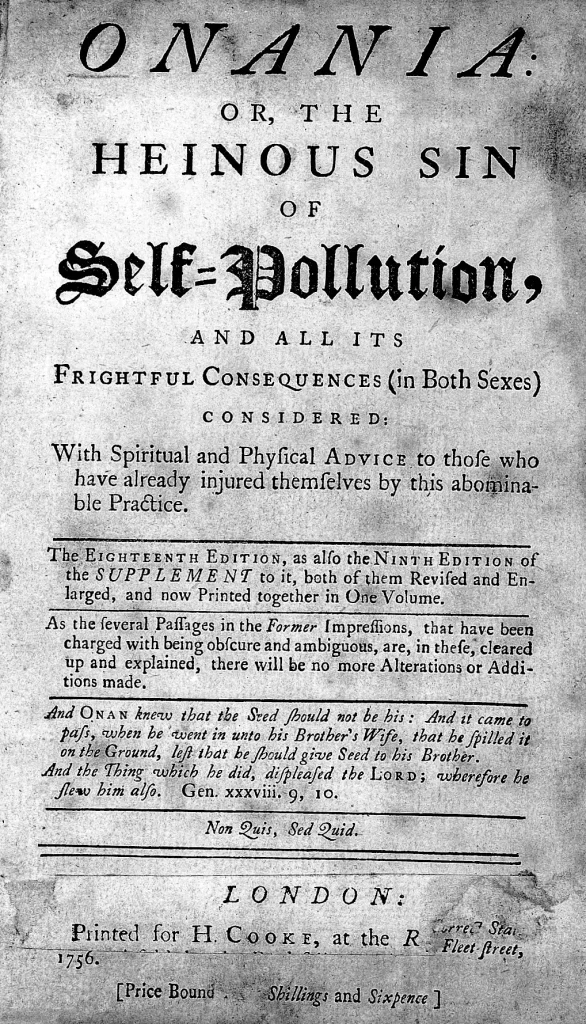
Moral takes of the religious variety provided influence into the medical world in the 18th and 19th centuries. We went from sin to sickness. Remember when you were told your palms would grow hair if you kept touching yourself? It came from propaganda in the form of a pamphlet being circulated in large cities like Boston and London. The pamphlet is called Onania (Shown below), based on the same story from The Book of Genesis. It is believed to have been published in 1716, and the actual author remains a mystery, often speculated that it came from an individual in the medical field. Other maladies they claimed could occur are blindness, insanity, and moral decay. The word of the church got in drag, became a medical professional, and sold a cure.
Dr. Kellogg took it to a new extreme though, and making cereal was one of his least harmful interventions. In the 1890s, Corn Flakes were put on shelves in grocery stores to get you to stop choking the chicken or flicking the bean. John Harvey Kellogg, AKA Dr Kellogg, (no, I’m not kidding about this) believed that a bland diet would remove temptation to touch yourself, and sold his cereal to create said blander diet. Yes, the cereal you still see on shelves today. Gives Frosted Flakes a little bit more of a rebellious edge now, doesn’t it? Dr. Kellogg was on a mission to push the Onania agenda forward and went to extreme measures to do so. He often cited masturbation as the underlying cause for many ailments his patients came to him for. He performed circumcisions without anesthetic, even on himself. This is cited as one of the most influential reasons circumcision is still popularized in America. He poured acid on the clitoris to de-sensitize nerve endings. These “preventative” procedures were done in the name of controlling sexual impulses. Even today, we still have traces of Corn Flakes boy lingering in our culture, almost like he spilled his seed and never brought a towel for America to wipe off with.
We’ve gone from Egyptian affirming rituals to unhorny cereal in a short amount of time, but the 20th century is when the narrative began to change. 1948, enter Alfred Kinsey, a zoologist studying wasps before his renowned pivot to human sexuality which pushed normalcy back into the conversation. His studies were a breakthrough for studying private sexual behavior. A striking 92% of the men in his sample study disclosed they masturbated. A short five years later, he published the female equivalent research, and the US lost its god damn mind. Turns out, people felt more comfortable justifying this behavior for men over women. Shocked. Church and medicine just spent centuries telling people what they shouldn’t be doing. Kinsey just listened to what they were actually doing. Masters and Johnson watched. The immersive research was the core of Human Sexual Response, observing nearly 700 individuals participating in sexual intercourse or masturbation. Collecting data on heart and breathing rate, and debunking the myth that there were direct negative side-effects to self-pleasure. Rounding out recent findings from Harvard University that have followed over 30,000 men from 1992 – 2010, with evidence suggesting that men who ejaculate more than 21 times a month significantly decrease their risk of prostate cancer. Modern medicine, ethical research and advances in scientific findings essentially reduce to one statement: Stroke it if you got it.
History shows us the origin point of shame. While we can never erase it, we can see how misinterpreted information can have a butterfly effect that lasts centuries. Why does International Masturbation Month exist? Maybe the real question that we should be asking is how much of this is still alive in us today. Are you still experiencing shame around your “Self-care” time? How have others navigated deconstructing those beliefs? If they choose to, that is. The origin point is clear. What we did with it next, in our personal lives, is a different story.